

==> 4 Reasons to Incorporate Single Leg Training into your Program:
- It’ll make your squat and deadlift go up! You can’t rely on your stronger leg to compensate for the weaker one.
- Stability and body control- something we ALL need, especially for sports specific training and for maintaining function as we age.
- Forced focus on quality movement over moving big loads. Let’s face it, you’ll never split squat as much as you back squat. Knowing that allows you to leave your ego at the door and strive for quality over meathead mode.
- Real life application: How often in real life do you squat or deadlift with a symmetrical load in a bilateral position? In everyday life, bending and squatting in a semi-single leg stance happens all the time.
Unilateral leg movements WILL make you stronger in your squats, deadlifts, etc. but probably more importantly, they transfer better into sports and life. Continue below for some of our favorite movements.
Lunge Variations:
Lunge variations are huge for developing single leg strength- from quad/knee strengthening, to developing hip and glute power.
 Here are a few of our favorites:
 Rear Foot Elevated Split squats:
Stability/coordination/
Front Rack Reverse lunges:
Front rack =upper back/thoracic/core strength training. Taking a reverse lunge (stepping back rather than forward) places more of an emphasis on the hips rather than the knees. These are a great accessory movement to incorporate on a leg day as 3 to 4 sets of 8-10 reps each leg.
Dual KB Rack Step Ups: AKA- front rack lunge on steroids.  🙂
🙂
The kettlebell front rack position adds a BIG challenge increasing the work on the upper back and core. As a step up, be sure to drive thru the heel of the top foot, and try not to push off on the back leg. Start light with 3-4 sets of 6-8 reps each leg as an accessory leg exercise once a week.
Single Leg Deadlift Variations:
Single leg deadlift variation exercise benefits:
-hip and posterior chain strength/power,
-balance and stability of the foot, ankle, hip, and lower back.
**To really test your stability skills, train these movements barefooted!
- Single Leg Kettlebell Deadlift: If you’ve never done single leg deadlifts, start here! Holding 1 kettlebell and bending with a single leg will work your core as well as the posterior chain. Start with 3-4 sets of 8-10 reps each leg once a week to develop balance and coordination. Once proficient, you can move to the single leg barbell deadlift.
- Single Leg Barbell Deadlift: Similar to the kettlebell deadlift, but with the length of the barbell, your body will be working even harder to stabilize the load for each rep. As you develop proficiency, you can increase the barbell load, but just know it will be MUCH lighter than you can deadlift or squat. Again 3-4 sets of 8-10 reps each leg are a good starting point once a week.
- Single Leg Landmine Deadlift: This is a great variation for those having trouble with the balance element of the single leg deadlift. The landmine “anchors” and stabilizes somewhat, allowing you to increase the load used. If you don’t have a landmine apparatus, simply wedge the end of a barbell in a corner or between 2×45# bumper plates to keep stable.
- Single Leg GHD Hip Extensions: By using a GHD, this movement removes much of the balance limitations of the SL deadlifts, and allows you to focus more on strength building. Once proficient with 15+ reps each leg unweighted, you may start adding weight by hugging a plate/DB/KB to your chest.
Single Leg Advanced Variations:
Once you’ve mastered the movements we covered earlier in the week, here are some more advanced single leg movement variations:
How has single leg training helped our clients?
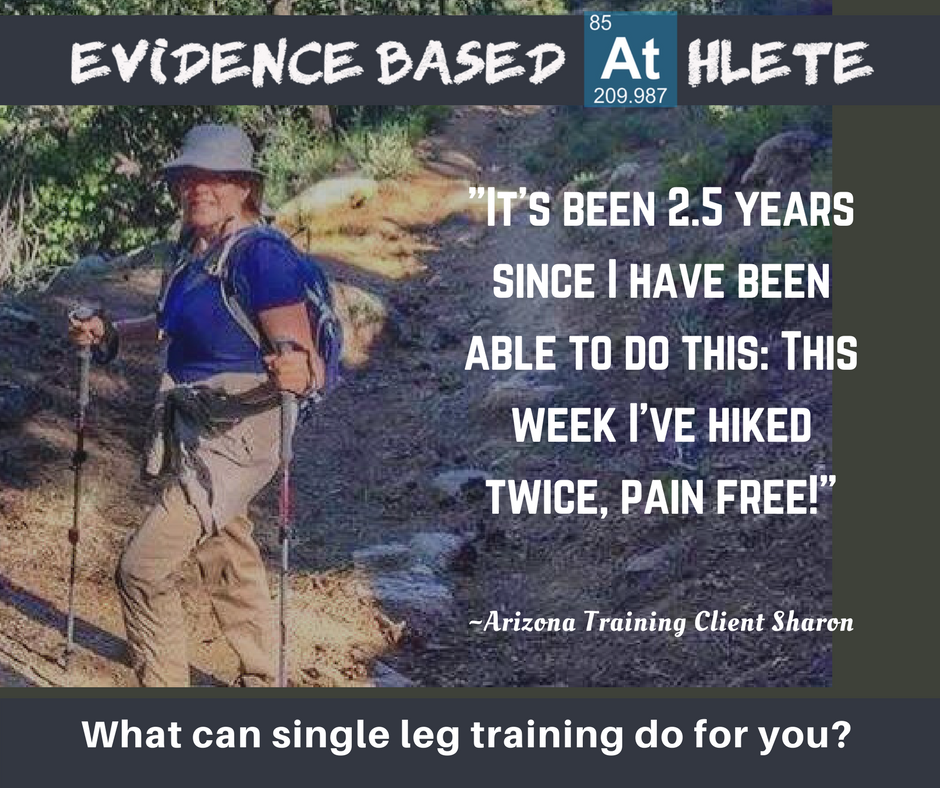
“All the strength training Coach Nicole has put me through has helped me get back on the trails. It’s been 2.5 years since I have been able to do this. This week I’ve hiked twice, pain free, and box step ups of course. I’m excited!!!”
– Arizona training and nutrition client Sharon B.